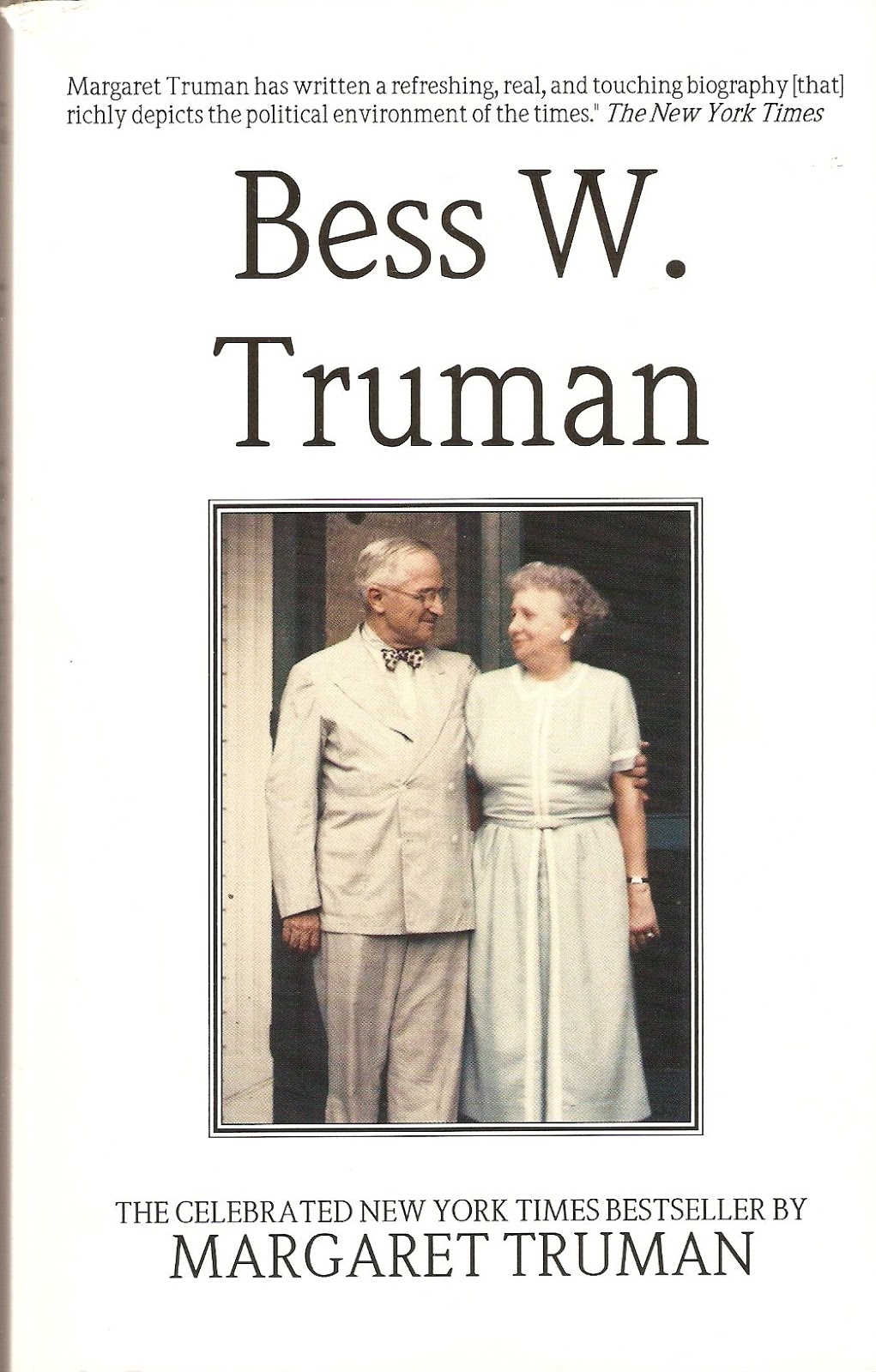
I'd wanted to read one (or both) of Margaret Truman's biographies of her parents for awhile, but since they're out of print, they're somewhat hard to find. I happened upon
Bess W. Truman (published in 1986) in a used bookstore earlier this year, and I snapped it up. Realizing that I could fit in several more books this month than I'd thought, I decided it was the perfect time to begin the book. I'm of two minds regarding this one. On the one hand, it's well-written and fair in its portrayal of Bess Truman, which can't be easy for a daughter to do. On the other hand, much of it was boring. I think the book could have been a hundred or so pages shorter (it's 430 pages), and nothing would have been lost. It took at least one hundred pages before Bess and Harry Truman were even married. It took I don't know how many more before Harry Truman became president, and then the book moved like a gazelle. I don't understand Margaret Truman's decision to spend so much time on Bess's early life and early marriage to Harry and so little on the White House years. Yes, Bess was more than a first lady, but she is
known for being a first lady. That's why people were reading the book, you can be sure. The biography relied heavily on early letters between Bess and Harry, which were quote ad nauseam. I eventually started to skim them. The dilemma here, is that Bess Truman, bless her soul, didn't lead a very interesting life. Here is an overview: She enjoyed her life and home in Independence, Missouri, loved her years as a Senator's wife, and detested her White House years. She was sharp-tongued and pessimistic. She didn't believe Harry would win his re-election bid in 1948, and though she was perhaps the most reluctant first lady (Michelle Obama has nothing on her), she always supported Harry's career and political decisions. This was a good, full portrait of Bess Wallace Truman, but it could have been improved if "cut by a third."
My rating: 3 stars.

I made the decision to read
Frankenstein this October (ahem) last year some time. I ended up fitting in so many books in September, though, that I "accidentally" finished
Frankenstein before October even began. Best laid plans, huh? At any rate, I've seen the classic Frankenstein movies many, many times, and I love them. I've been interested to see how faithful they are to the book, how the monster was portrayed, how the book was constructed, and how certain of my favorite parts were written. Boy was I surprised. The movies are not faithful to the book at all. I'm concerned about how much to compare and contrast here for fear of spoiling something for anyone familiar with the films who wants to read the novel. I will tell you there is no grave robbing, no "abnormal brain," no assistant Fritz, no lifting the lifeless monster's body up to the heavens to be zapped with lightening, no exclamation of "He's alive! He's alive!" The novel builds up sympathy for both Frankenstein and his monster, whereas the original movies probably focus more on the monster. Regardless of the jarring differences, I enjoyed the novel very much. Some areas were far-fetched (the monster is well spoken and quotes Dante's "Inferno") and some are skipped entirely (how the monster is created), but the story is wonderful, tragic, and thought-provoking. I've set up a DVD recording of Kenneth Branagh's "Mary Shelley's Frankenstein" which is supposed to be true to the novel. I'm excited to see how true.
My rating: 4 stars.

Okay, so I am of the generation of kids whose most vivid childhood memories involve playing "The Oregon Trail" off of a 5.25" floppy disk (when floppy disks were still "floppy") on an Apple IIe computer. This was "educational" back in the mid-1980s. Oh how I remember the shock of oxen death, the wagon's axel breaking, or one of my children (named after a classmate) drowning. It was heartbreaking stuff in third grade. And so it is that a whole generation of children have memories of traversing the country from Missouri to Oregon more than a hundred years after the pioneers did it.
The Oregon Trail has been on my TBR list for ages. It never seemed to be the right time to begin it, so I finally decided I'd have to listen to it to ever get it "read." It's a great adventure. As you know, I love books about odd quests and hair-raising adventures, so this was definitely in my wheelhouse. Author Rinker Buck, his brother, Nick, and Nick's dog, Olive Oyl, set out on the 2,000-mile journey in a covered wagon armed with maps, mechanical knowledge, and memories of childhood covered wagon travel with their father in the 1950s. Along the way, Buck, a passionate historian, discusses wagons, mules, pioneers, Mormons, and the trail itself. They get into plenty of scrapes, and Buck's storytelling style, similar to Bill Bryson's, is fun. But I do have some issues. First, the audio version is awful. It's narrated by the author, and while that would normally be a selling point for me, someone should have pushed for the author to not do the reading. He's a terrible reader, one who stops indiscriminately after every three words (literally), though there are no natural breaks in the narrative. It was so distracting, and I never got used to it. Second, there is a wagonload of swearing in this one. You couldn't even count the F-bombs if you wanted to. It was so disappointing. I'm not opposed to the occasional swearword in books (especially in nonfiction books with dialogue) when it's used for emphasis. But the amount of foul language in this book was just gross, and listening to it on audio made it even worse because my eyes couldn't edit it out. Last, Buck seems to have a disgust of organized religion. Some of the things he said about Mormons were ugly, and things he said about Christian beliefs in general were despicable. You don't have to be a Christian for me to read your book, but you have to disagree with respect. So, I had a hard time rating this one. I think it was a well-executed book with some flaws, and I tried to disregard the abysmal audio when I assigned my grade.
My rating: 4 stars.

I mentioned last week that I feel like I didn't give Louis Jenkins'
Before You Know It the attention it deserved because I started it so late in the month. Still, I feel that I didn't necessarily miss anything either. Perhaps my own enjoyment was diminished, but on the other hand, I marked dozens of the poems as ones I'd like to return to. I'd seen many of Jenkins' poems lately in The Writer's Almanac poem-of-the-day. He's known for his prose poems, and this collection is prose poems only. (Perhaps that's the only style of poetry he writes; I'm unsure.) This is a collection of his poems from 1970 to 2005, and it was interesting to read them in order and see how his poetry has evolved throughout the decades. The poems in the beginning of the anthology were much more fantastical with odd twists and elements of, for lack of a better word, fantasy. As the poems went on, they were much more concrete which happens to be my preference. I really enjoyed this collection, and I plan to read more by Jenkins.
My rating: 4 stars.
Next up:
I bought The Last Days of Night shortly after it came out, then got cold feet. While I love historical fiction, I get squeamish about historical fiction based on real events, in this case, the "battle to electrify America". I'm willing to put my qualms aside and give it a whirl, though. It seems like a good fall read, with the nights getting longer and longer.
Last week I began:
Last week I began Make Your Bed: Little Things That Can Change Your Life...and Maybe the World by Admiral William H. McRaven. This is based on a graduation speech, which is a book genre I kind of have a crush on. Plus, I love a Navy man.
I also started Poetry Will Save Your Life by Jill Bialosky. It's a series of short essays, each centered around a poem that touched her life.
My audiobook:
I'd been saving Bill Bryson's The Life and Times of the Thunderbolt Kid for a long time. I'd wanted to listen to it since Bryson is the narrator, and he's just wonderful in every way. But I got halfway through the first disk when I realized I really wanted to read this one as a book so that I could savor the descriptions and jokes. So I'll be switching over to my paper copy in October.
So that meant I had to find something in the library that was in my audiobook TBR, and I settled on The Mathews Men, about seven men from Mathews County, Virginia, who fight German U-boats in WWII. So far it's a typical war book. It would be a good companion to Erik Larson's Dead Wake.